

Support with your own knowledge
Answer recurring questions from approved product guides, show the source behind an answer, and pass uncertain requests to a person.
Connect AI to your existing tools, websites, and business workflows.
Discuss this project ↗Give an assistant the right context, connect it to an existing experience, and define how people review and use its output. The scope starts with a specific task.
Model APIs, knowledge sources, structured outputs, and your existing systems.
Identify the information, users, and decisions the integration should support.
Bring relevant documents or system data into the experience with clear access boundaries.
Put the assistant inside the website or tool where people already work.
Test relevant questions, uncertain answers, and human review requirements.
An AI feature becomes useful when it understands the task and has access to the right information. A generic chat window is rarely enough: a support assistant needs product policies, a document workflow needs an agreed output format, and an internal tool needs to respect who can see each record. We design the connection between the model, your information, and the person making the final decision.
Answer recurring questions from approved product guides, show the source behind an answer, and pass uncertain requests to a person.
Turn invoices, forms, or long documents into structured records, with validation and a review queue for incomplete information.
Help people draft, search, summarize, or compare without leaving the customer portal or internal workspace they already use.
We agree a focused scope, make the work visible, and test the important scenarios together.
Choose the users, information sources, expected output, and situations where the assistant should ask for help.
Connect approved documents and APIs, control access, and shape the response into something your application can use.
Review representative questions, missing context, misleading inputs, response time, and usage cost before launch.
Provide human review, useful logs, and a way to improve the knowledge and prompts as the workflow evolves.
Yes. We first assess their format, freshness, ownership, and access rules. Search and retrieval can bring relevant passages into the answer, with source references where useful.
That depends on the task. Drafting or suggesting a next step can be automatic; sending messages, changing records, or making sensitive decisions can require explicit human review.
The agreed application code, integration configuration, evaluation examples, and setup documentation. Model providers and ongoing usage costs are chosen and discussed as part of the scope.
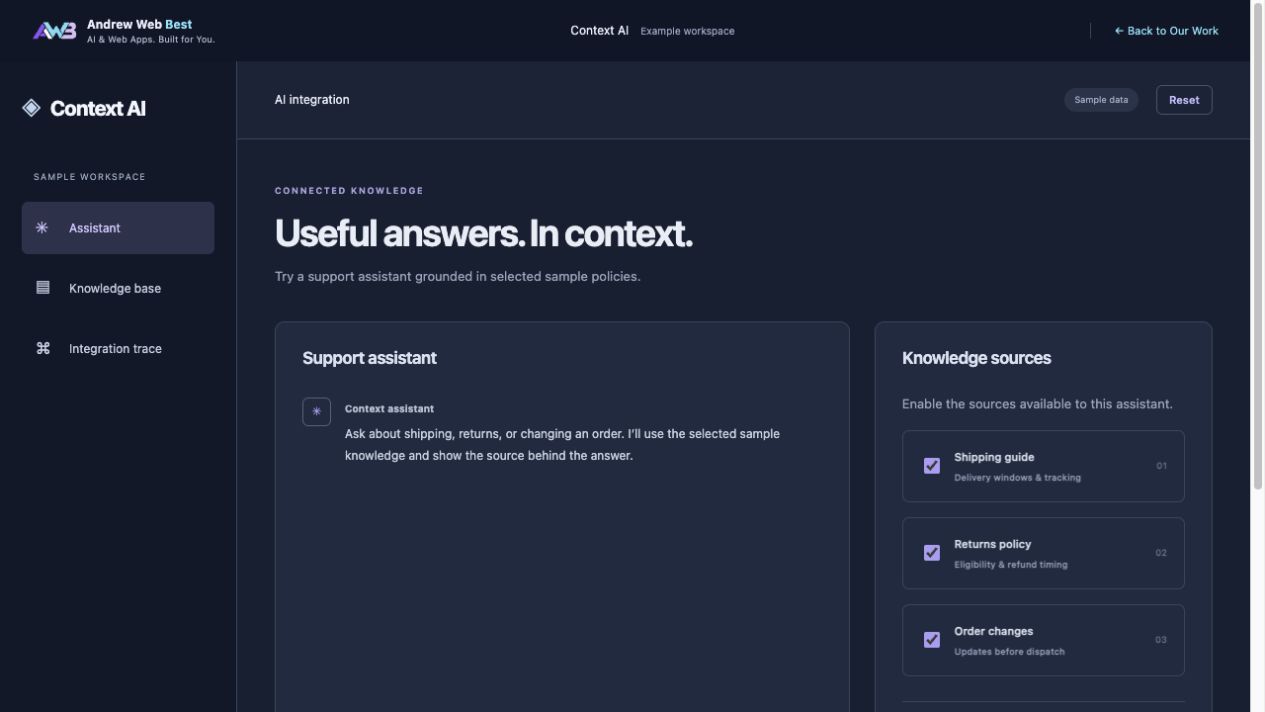
Explore a support assistant connected to sample knowledge, with cited answers and handoff behavior.
Explore the app ↗Manage stock, inspect products and try a voice workflow that matches items, validates changes and updates a fictional inventory.
Explore the app ↗A new product, a better workflow, or an idea worth testing.